Is restorative justice removed from reality?
Yes, bureaucratically, but not humanly.
Restorative justice was badmouthed in the kerfuffle around a nasty situation involving bad behavior by some students that inspired the principal to suspend them. Some restorative justice advocates had the temerity to publicly speculate on some ways that the principal could have done something different. The author of an article for EducationHQ.com interviewed “a school leader and author” who suggested that those speculations were “breathtakingly out of touch” and “just not practical in any way.”
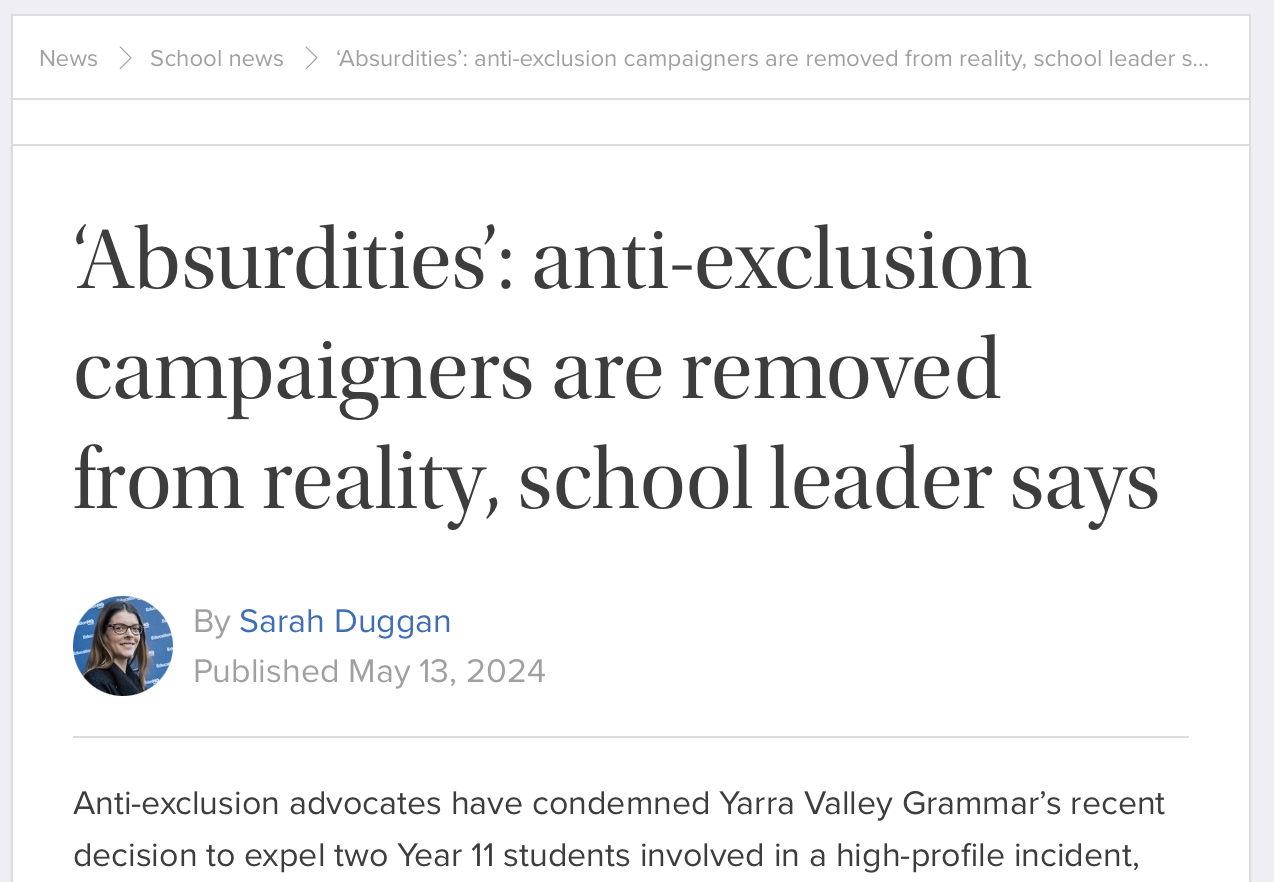
Understanding who is right and why requires insight into the context of this situation and the following kerfuffle. The expulsion of the students occurred at a private school in Melbourne, Australia. By taking that particular action the school was protecting its reputation by signaling their intolerance of bad behavior to the wider community. They were acting in the best interests of the school, not the children. Having said that, you might suppose that I disagree with the school leader who claimed that restorative justice is “just not practical in any way.” However, you would be wrong. I believe that both sides are right because they are each taking a very specific vantage point.
The Leader’s Perspective
I agree with Dr. Greg Ashman, the school leader and author who was interviewed, if we are making one key assumption about the school. The assumption that makes his sentiment true is that the school is effectively a bureaucracy. By bureaucracy I mean what the famous sociologist Max Weber meant by the term. A bureaucracy is any organization that is based on strict hierarchy, roles defined by rules that are expected to comprehensively define everyone’s activities, and who has what authority within that hierarchy. On the assumption that Dr. Ashman is referring to bureaucratic schools he is absolutely right. It is a defining characteristic of every bureaucracy that the needs of the organization must take precedence over all other concerns. Removal from reality occurs when restorative justice is expected to work within a bureaucracy. It is even more difficult to reconcile that with reality if restorative practices were introduced by bureaucratic mandate (a typical situation here in the USA recently).
Bureaucratic Reality is Inhuman
We can also see that Dr. Ashman was removed from the reality of human nature. All humans, no matter their age or any other demographic characteristic, gain access to well-being through having their needs for relatedness, autonomy, and competence satisfied. The decrements in well-being that result from having those needs thwarted will also have detrimental effects on learning.
Bureaucracies are famously alienating places. That alienation is the predictable result of having those universal psychological needs thwarted. If Dr. Ashman believes punishment is the appropriate course of action for ensuring those students do not behave poorly over the long term, he is wrong. Punishment has predictable detrimental effects on relationships and autonomy. Research on the effects of punishment has shown that doing it unfairly causes significant negative effects and doing it fairly has less bad but still negative effects. Dr. Ashman is correct about the “necessity” of punishment in bureaucratic schools, but he is delusional if be believes that the punishment is good for anyone other than the school.
Humanity is at the Heart of Restorative Justice
The whole idea of restorative justice is about honoring each person’s experiences. Any mandate from afar is, by definition, divorced from the people involved. Trying to install restorative practices within an impersonal bureaucracy is where the removal from the reality of human nature occurred. All the speculations in the article about how to handle the situation were just fantasies, no matter which side they were on. That’s exactly the problem with impersonal bureaucracies, nothing about any individual matters. The bureaucracy creates the vile behaviors and then fails to solve the problem because it’s an impersonal system that is incapable of doing so. Kicking-the-can-down-the-road behavior is inevitable when bad behavior occurs within a bureaucracy.
My Commentary
After I made something like the above points in a comment on Dr. Ashman’s posting of the article on LinkedIn, I got this response: “Sometimes kids need to feel the punitive hand of the society they inhabit if they are engaging in seriously anti-social behaviour. (Boys in particular.)” This made me realize that there are effectively two realities to draw on here. There are those that are embedded in bureaucratic reality and those that are responding from a perspective outside that reality (even if they may be at least partly embedded in one.) From the perspective from within the bureaucratic reality, punishment is logical and “effective.”
From outside that reality punishment is primarily a mechanism that exacerbates a situation in which some members of the community have thwarted the needs of others. The precipitating incident necessarily alienates the victims and the response by the bureaucracy is likely to result in alienation of the perpetrators, as well. There is no regard for the possibility that the human relationships at stake are important or valuable. There is no regard for the possibility that the situation of the bureaucracy is, in itself, the cause of the dysfunctional behaviors.
In my reply to that comment I stated, “‘Punitive hands’ are not helpful. They exacerbate problems, not solve them. The challenge is ensuring that there are consequences for harmful behaviors without either making the problem worse or kicking the can down the road. There are ways to do that; I study schools that have worked it out. Most of them do not operate within bureaucracies. The few that do have worked out ways to insulate teachers and students from the worst aspects of the bureaucratic systems in which they are embedded. Then from within that insulated space they use restorative practices.”
When there is something other than a bureaucracy in which to operate (if only within an insulated space within one) then it is patently absurd to try to deal with dysfunction by perpetuating more dysfunction. When we recognize that human nature requires us to honor everyone’s needs for relatedness, autonomy, and competence, we recognize that punishment is likely to make the situation worse and inevitably kicks the can down the road. Bureaucracy is bad for human beings, by definition. The movements to expand the influence of restorative justice are a good idea, but there also needs to be clear recognition that effective implementation of restorative justice also requires the movement to simultaneously be anti-bureaucracy.
This article was printed from HolisticEquity.com
Stay informed by joining at FullyEngage.org.
Recent Articles


-
Host Schools Wanted
May 10, 26 12:25 PM
QuixotiCon is an EdCamp-style in-person unconference for local educators who recognize that nurturing children is the only true foundation for educating them. -
Is restorative justice removed from reality? Yes, sort of.
Mar 21, 26 02:22 PM
 Restorative justice is delusional when it is embedded in bureaucracy without carefully maintained protections from the meddling of bureaucrats.
 -
Defense Against The Dark Arts Course Interest Page
Mar 13, 26 02:42 PM
 The Defense Against the Darks Arts course for distinguishing education from indoctrination is in development, learn more here.